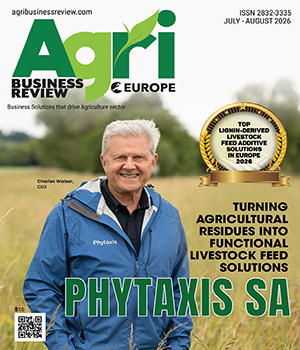
 Charles Walser, CEO
 For decades, lignin was viewed in animal nutrition mainly as an indigestible component of plant material with little nutritional value. That perception is beginning to change. Advances in processing, analytical methods and animal nutrition are showing that certain lignin-derived materials can have functional properties that extend well beyond their traditional role as fibre. However, there is an important distinction the industry needs to make. Lignin is not one uniform substance.
Its properties depend strongly on where it comes from and how it is extracted and processed. Botanical source, extraction technology, purification, chemical structure and subsequent modification can all influence the characteristics of the resulting material. Kraft lignin, lignosulphonates, sulphur-free soda lignin and lignins closer to their native structure should therefore not automatically be expected to behave in the same way.
This distinction is particularly important when discussing lignin-derived ingredients for animal nutrition. Generalizing results obtained with one type of lignin to the entire category can create misconceptions and make it more difficult to understand where the real opportunities lie.
Looking Beyond Lignin as a Nutrient
One of the lessons we have learned from almost two decades of working with lignin-derived ingredients in animal nutrition is that their value should not necessarily be considered in the same way as conventional nutrients.
Selected and appropriately processed lignins can act primarily within the gastrointestinal environment. Their complex structure and polyphenolic characteristics provide surfaces capable of interacting with components present in the intestinal lumen. Depending on the material, these interactions may contribute to conditions that favour intestinal function, microbial balance and efficient nutrient utilization.
This changes the question we should be asking.
Instead of asking how much nutritional value lignin itself provides, we should increasingly ask whether a particular lignin structure can help create a gastrointestinal environment in which the animal can use the rest of the diet more effectively.
That is a fundamentally different proposition.
From Corrective Intervention to Preventive Nutrition
Animal production has traditionally relied heavily on interventions designed to address individual problems once they occur. Modern nutrition is increasingly moving toward prevention and resilience.
This does not mean that functional feed ingredients should be presented as replacements for veterinary medicine. They are not. Their potential lies in supporting animals before corrective intervention becomes necessary.
A more resilient intestinal environment, efficient nutrient utilization and stable digestive function can contribute to more predictable production. This approach becomes particularly relevant as producers face increasing pressure to reduce routine antibiotic use while maintaining performance.
The future of animal nutrition may therefore depend less on finding one additive for every individual challenge and more on understanding how different nutritional tools influence the entire biological system.
The future of lignin in animal nutrition will not be determined by how much lignin we can put into feed, but by how well we understand which lignin structure delivers which function.
Sustainability Opens the Door, Performance Keeps It Open
Lignin also has an attractive sustainability story. It is one of the major structural components of plants and can be recovered from agricultural residues and other lignocellulosic raw materials that are often underutilized.
-
The future of lignin in animal nutrition will not be determined by how much lignin we can put into feed, but by how well we understand which lignin structure delivers which function.
Turning such side streams into functional feed ingredients supports a more circular use of biomass and reduces dependence on resources that compete directly with the food chain.
But sustainability alone is not enough.
Commercial animal nutrition is highly performance-driven. Every ingredient occupies formulation space and adds cost. A renewable ingredient therefore earns its place only if it is safe, consistent, scalable and capable of creating measurable value for the producer.
This is an important principle as interest in bio-based feed ingredients increases. Sustainability may create interest in a new material, but only reproducible functionality will lead to long-term adoption.
The Next Step Is Better Understanding
The opportunity for lignin-derived feed ingredients is therefore not simply to introduce more lignin into animal diets. The real challenge is to understand the relationship between lignin structure, processing and biological function.
That will require better characterization of different lignins, reproducible production processes, species-specific research and validation under commercial farming conditions. It will also require restraint in how the category is described. Results obtained with one lignin material should not automatically be attributed to another.
At Phytaxis, our experience has made us increasingly convinced that this differentiation is essential. The term “lignin” describes the starting point, not the functionality of the final feed ingredient.
If the industry can move beyond viewing lignin as a single material and instead understand how different lignin structures can be designed and applied for specific purposes, an abundant plant polymer once considered largely unsuitable for nutrition may become an increasingly valuable tool in more efficient and sustainable animal production.
Advancing Livestock Nutrition through Functional Lignin Innovation
European livestock producers face a tightening set of constraints that extends beyond productivity targets. Pressure to reduce reliance on antibiotics, manage input costs and demonstrate environmental accountability is reshaping how feed strategies are evaluated. Conventional additive models, built around supplementation rather than systemic gut interaction, often struggle to reconcile performance gains with these evolving expectations. The shift underway is less about incremental improvement and more about rethinking how a single input can simultaneously influence multiple biological and operational outcomes.
Feed decisions increasingly hinge on whether an additive can deliver measurable improvements without forcing trade-offs. Growth performance remains central, yet it is no longer sufficient in isolation. Producers are examining how efficiently nutrients are converted, how consistently animals maintain health without intervention and how downstream effects such as waste output or water quality are influenced. This broader lens reflects a move toward inputs that operate within the animal’s digestive system to support balance rather than correction.
Another emerging expectation is compatibility with reduced-input feeding strategies. Rising volatility in feed ingredient pricing has made it necessary to extract more value from lower-energy or lower-protein formulations. Additives that can sustain or improve outcomes under these conditions are gaining attention, particularly when they enhance nutrient utilisation rather than simply compensate for deficiencies. This distinction separates short-term supplementation from longer-term efficiency gains.
Adaptability across species and production environments also plays a decisive role. Livestock systems are not uniform, and solutions that require extensive reconfiguration for each application create friction in adoption. Buyers increasingly favour approaches built on a consistent underlying mechanism that can be adjusted at the formulation level without losing effectiveness. This allows producers to apply a unified strategy across poultry, swine, aquaculture or early-stage cattle development while accounting for biological differences.
Quality assurance and traceability have become non-negotiable elements in supplier evaluation. The ability to control raw material sourcing, maintain consistent production standards and verify the absence of contaminants directly influences confidence at the farm level. Certification frameworks and rigorous batch testing are no longer peripheral considerations but integral to how feed inputs are assessed for long-term use.
Within this evolving landscape, lignin-derived feed additives have moved from a peripheral concept to a subject of serious evaluation. Their role as insoluble fibres that interact within the gut offers a different pathway compared to microbial or enzymatic additives. Rather than introducing external biological agents, they influence the internal environment in which digestion and microbial balance occur, creating conditions that support healthier and more efficient nutrient processing.
Phytaxis SA exemplifies how this approach can be translated into a scalable solution. It has developed a sulphur-free lignin platform produced through proprietary extraction processes, enabling consistent quality and biological activity. Its formulations, largely built on a single modified lignin base, are tailored for species-specific needs while maintaining a unified mode of action. The result is observable improvements across metrics that matter to producers, including feed conversion, growth outcomes and reduced reliance on antibiotics. In aquaculture settings, it improves water quality by reducing ammonia and solid waste, while in terrestrial livestock, it supports gut health and lowers mortality. Its vertically integrated production and adherence to recognised quality standards reinforce supply reliability, positioning it as a credible choice for producers seeking performance gains aligned with modern constraints.
...Read more